
Swappable
In ninety days, Washington switched off two frontier models, gated a third before launch — and renewed every platform they plug into. The federal ledger has been keeping score.

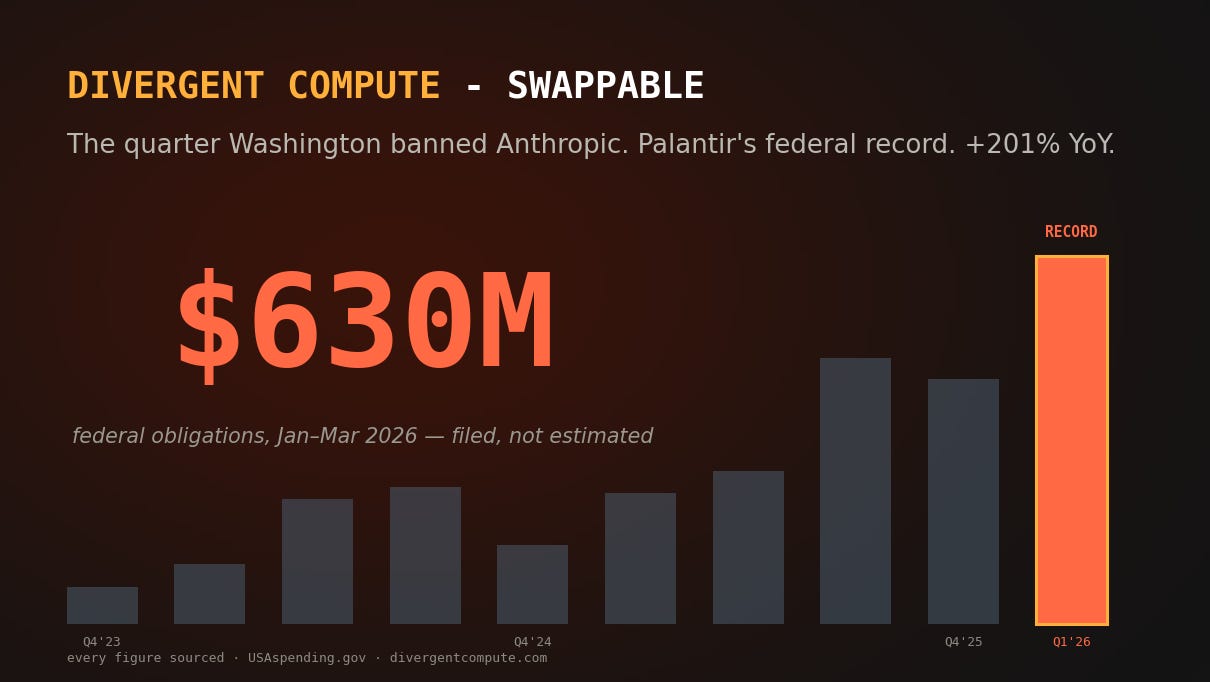
In ninety days, the US government switched off two frontier AI models, gated a third before its launch, and reversed itself once. In the same ninety days, it renewed, raised, or expanded every major government platform those models plug into.
The market drew one conclusion, and this week it said it out loud: models are suppliers. Deployment is infrastructure.
The ninety days
Feb 27 — Federal agencies directed to cease using Anthropic; the Pentagon designates it a “supply chain risk.” The model affected was, until that day, the only frontier model approved on classified networks.
Apr 7 — Anthropic itself withholds its Mythos-class model from general release over cyber-offense capability, limiting access to defensive-security partners.
Jun 2 — An executive order creates a voluntary pre-release evaluation framework: developers may give the government up to 30 days of pre-launch access; vetted “trusted partners” get early availability.
Jun 12 — An unpublished Commerce export directive forces Anthropic’s two newest models offline worldwide. The order’s text, rationale, and legal basis were never made public.
Jun 25–26 — The White House asks OpenAI to limit its GPT-5.6 launch to government-vetted partners. OpenAI complies, objecting that this “shouldn’t become the long-term default.”
Jun 30–Jul 1 — Commerce reverses the export directive after 18 days.
On paper, none of this is a licensing regime: the June order is expressly voluntary, and the export controls lasted eighteen days. What the ninety days established is something an investor can price anyway — precedent. Access to frontier models is now politically conditional, revocable without published reasons, on a timeline of days. A former White House AI adviser called the GPT-5.6 arrangement “a de facto involuntary licensing regime.” The model layer acquired a regulator-shaped risk.
What got restricted, and what got renewed
Here is the part the restriction headlines skipped. The model the Pentagon switched off in February was not sitting in a lab — it was running inside the Pentagon’s own flagship AI platform, Palantir’s Maven Smart System, where it had just been used operationally. The government banned the component and kept the platform. Then it kept buying the platform:
May 2025 — Maven Smart System ceiling raised by $795M, to $1.3B through 2029
Aug 2025 — Army enterprise software and data agreement: up to $10B over ten years
Feb 19, 2026 — DHS blanket purchase agreement, up to $1B — eight days before the Anthropic directive
Mar 2026 — Expanded role in a new Pentagon AI contract
Jul 1, 2026 — Army NGC2 selects Foundry as its data layer; an Nvidia partnership for government and critical-infrastructure AI lands the same day
That is Washington’s revealed preference, stated in procurement rather than policy: the model is a component; the platform is the system of record. Components get swapped. Systems of record get renewed.
The meter
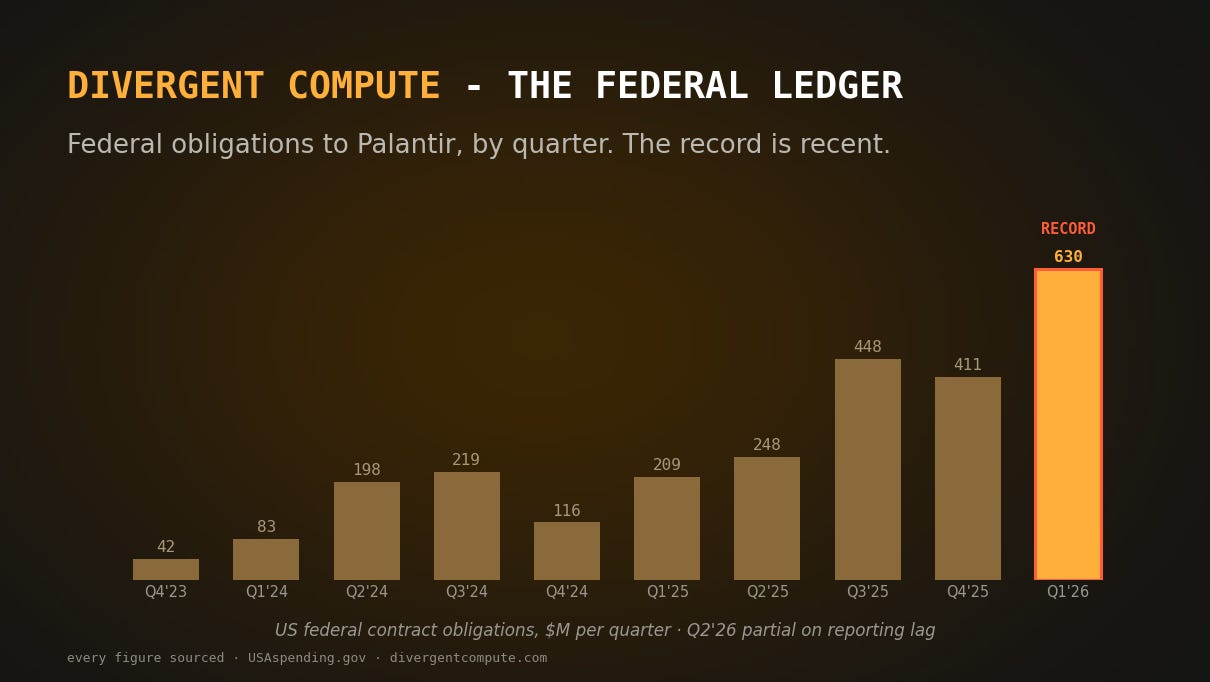
We pulled every federal contract obligation to Palantir from USAspending.gov, by quarter. FY2024: $541M. FY2025: $1.02B, up 88 percent. The first two reported quarters of FY2026 alone: $1.04B — including a record $629.7M in January–March 2026, up 201 percent year over year, the quarter of the federal ban on Anthropic. (April–June shows $295M and is incomplete; agencies report on a lag. We refresh it as the lag clears.)
Now the caveat we owe you: the ramp predates the ban. October–December 2025 was already up 255 percent year over year. This series shows an era, not an event — and that is precisely the claim: across the window in which model access became politically conditional, money to the deployment layer compounded without interruption. The company’s own filings corroborate: US government revenue of $687M in Q1 2026, up 84 percent year over year.
The integrator premium → Δ(federal obligations to the deployment layer) against Δ(political conditionality of model access). Refresh: quarterly, from USAspending.
The market said it out loud
July 1: the stock rose 9.3 percent in a session on three headlines at once — the Nvidia sovereign-AI partnership, the Army NGC2 selection, and a financial disclosure showing the President personally holds a Palantir stake of at least $1 million. July 2: a D.A. Davidson upgrade made the logic explicit — the restriction episode showed the risk of depending on any single frontier provider, while a company built on an orchestration layer “would only experience a minor transition as Palantir swaps the AI models underneath its solution.”
The word doing the work in that sentence is swaps.
This premium has a public bear on the other side of it. Scion Asset Management disclosed roughly $912M notional in Palantir put options on November 4, 2025 — the CEO’s same-day response on television: “batshit crazy” — and the stock still trades about 44 percent below its November peak. At roughly 59x trailing and 36x forward sales (July 2), the most public disagreement in this market is precisely about whether political standing is a durable moat. We take no side. We publish the meter.
And the CEO’s own July 1 broadside against the frontier labs — “tokenmaxxing,” a “wealth tax” on business, models “completely, irresponsibly, oversold” — reads cleanly once you hold it against the asymmetry above: renting frontier intelligence by the token is politically fragile; owning the deployment layer is the product. He praised Anthropic’s CEO personally in the same interview. It is positioning, and it is consistent.
What the record does not show
A thesis this convenient deserves its own cross-examination, so here is everything the record refused to give us.
We found no evidence Palantir advocated any of the restrictions. Its March 2025 policy filing asked for faster procurement and agency AI mandates — deregulatory for deployers, silent on restricting developers. We found no statement by its CEO calling for gating frontier models — his attacks are on the labs’ pricing, enterprise IP posture, and reluctance on defense work, never on their freedom to ship. The February ban imposes a real cost on Palantir: the banned model has to be migrated out of its own flagship platform. And the restriction regime itself is thinner than the era’s headlines — a voluntary framework and an eighteen-day export order.
Anyone telling you the politically connected engineered the whistle is asserting past their evidence — and so would we be. What can be measured is not who caused the restriction era. It is who the restriction era pays.
The network, as a ledger
Dated entries, no arrows:
The Federal CIO (named Jan 2025, later also federal chief AI officer) spent ten years at Palantir.
The HHS CIO (May 2025) spent thirteen; HHS holds Palantir contracts.
An Under Secretary of State (confirmed Oct 2025) was senior adviser to Palantir’s CEO, with ~$840K of Palantir consulting compensation disclosed.
Both signatories of the administration’s AI Action Plan are alumni of the Thiel network. Thiel is Palantir’s chairman and largest shareholder.
Lobbying spend: $2.4M (2020) → ~$6.1M (2025), per OpenSecrets.
Jul 1, 2026: a presidential financial disclosure shows a personal Palantir stake of at least $1M.
These are entries, not arrows. A ledger without the network column would be incomplete; a ledger that drew causal lines the record hasn’t drawn would be fiction. (One widely circulated figure — 144 administration appointees with Palantir financial ties — traces to a secondary tracker and is excluded until we verify the underlying disclosures ourselves.)
What would prove us wrong
1. If federal obligation growth to the deployment layer decelerates below its pre-restriction trend across the next two reported quarters, the “restriction era pays the integrator” reading fails — and we publish the failure.
2. If the forced model migration produces documented degradation or contract loss in the flagship platform, “swappable” fails.
3. If the Q2 lobbying disclosures (due ~July 20 — the first filings covering the June directives) show Palantir advocating model restrictions, our “no evidence” finding gets corrected, in public.
Dated next readings: ~Jul 20, the lobbying disclosures. Rolling, the April–June obligations as USAspending lag clears. Early August, Q2 earnings — the US government revenue line, read against this page.
Every figure above is from USAspending.gov, SEC EDGAR, official executive orders, or dated press reports — sources listed on the web edition at divergentcompute.com/swappable. Part of the Policy Ledger series, following “OPEC for Tokens?”